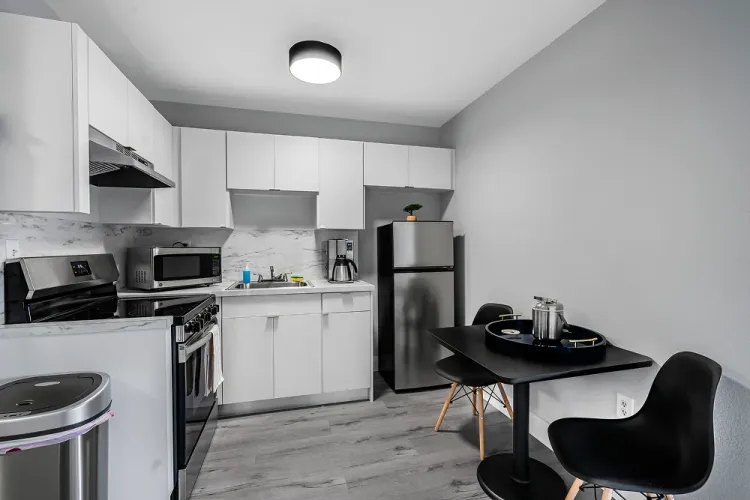
Real estate photography vs phone photos
What actually sells a listing in Tallahassee and North Florida — the buyer data, the craft a phone can't replicate, and why your listing's first showing happens on a screen.
Two homes, same street, same price. One gets a wave of saves and three showings its first weekend. The other sits. More often than not the difference isn't the house — it's the first photo. Because in today's market, your listing's first showing doesn't happen at the front door. It happens on a phone screen, in the two seconds a buyer takes to swipe past or stop. Here's the honest case for professional real estate photography over phone photos: what the data says, what a camera can actually do that a phone can't, and why it matters for every listing across Tallahassee and North Florida.
Buyers shop with their eyes — and they shop online first
Start with what isn't up for debate. In the National Association of Realtors' 2024 buyer survey, every single buyer used the internet during their home search, and looking at properties online was the most common first step — ahead of calling an agent. Nearly 7 in 10 searched on a phone or tablet. And when buyers were asked which website feature they found most useful, photos came out on top — rated "very useful" by more buyers than detailed property info or floor plans. More than half found the home they actually bought through an online search.
Read that again: the listing photo isn't marketing for the showing. For most buyers, it is the showing — and it's happening on a four-inch screen, in a feed full of competing homes.
The photo carries the listing
There's hard evidence for where a buyer's eyes actually go. A peer-reviewed eye-tracking study (Seiler and colleagues, 2012) sat buyers in front of listings and watched what they looked at: almost everyone went to the main photo first, and they spent roughly 60% of their attention on the photos — far more than the written description or the agent's remarks. It's a lab study and it's a decade old, but the takeaway is timeless: the hero image does the heavy lifting. A buyer decides whether your listing is worth their time from a picture, before reading a single word.
What a phone simply can't do
Here's where the craft matters — and it's the part a newer phone won't fix. The hardest shot in real estate is a bright room with a window. On a sunny day, the world outside that window is ten to fifteen times brighter than the inside of the room. A single phone exposure can't hold both: it either blows the window out to a glowing white rectangle or crushes the room into shadow. You've seen it — the photo where the "view" is just blank glare.
A professional solves this with technique a tap can't replicate:
- Flambient — blending a natural-light frame with flash to get true, accurate color instead of muddy indoor casts
- HDR bracketing — merging several exposures so highlights and shadows both keep their detail
- The "window pull" — exposing separately for the view outside and compositing it back in, so the room and the view read the way they look in person
Then there's the lens. Pros shoot wide — but corrected wide — so a room feels open without the warped, leaning-walls "funhouse" look a phone's ultrawide gives you. Straight verticals, honest proportions, no distortion that quietly tells buyers something's off.
The Florida problem
This matters more here than almost anywhere. North Florida light is brutal on a camera — harsh midday sun, glare bouncing off water and tile, and the signature challenge of a lake or Gulf view you're trying to keep visible through the window. Shoot a Tallahassee home or a coastal listing at noon with a phone and you'll lose the view, the room, or both. A pro times exteriors to golden hour, cuts glare with a polarizing filter, and blends exposures so the view out the window survives. The thing that sells the home is exactly the thing a phone is most likely to throw away. (For coastal listings, that's also where a drone aerial earns its keep — proving the water and the location no ground shot can.)
What the price and speed data actually shows
Does better photography move price and days-on-market? The honest answer: the strongest hard numbers are real but older, so we'll cite them with their dates rather than dress them up as current. A widely-referenced 2013 Redfin study found homes between $200K and $1M sold for roughly $3,400 to $11,200 more relative to their list price when shot with a professional camera versus an amateur one — and that listings with the sharpest photos sold at or above list price 44% of the time, versus 13% for average-sharpness photos. A 2014 industry analysis (VHT Studios) found professionally photographed homes sold about 32% faster.
Those studies predate today's phone cameras, so we don't lean on them as gospel. The most rigorous recent work — a 2024 NBER paper — found rich listing media still helps, but the edge has narrowed as everyone adopts it. Which is exactly the point: the advantage today isn't a gimmick or a magic number. It's doing the fundamentals well while a lot of listings still go up with dim, distorted phone snaps.
The phone-photo tells
You can usually spot a phone-shot listing in a second. The giveaways:
- Blown-out windows — a white glow where the view should be
- Dark, muddy rooms that read smaller and older than they actually are
- Leaning walls and bowed lines from an ultrawide phone lens
- Off color — yellow-orange casts from mixed indoor lighting
- Clutter left in frame, because nobody staged or composed the shot
Your listing deserves better than your phone
None of this means your phone is useless — it means a home you're asking real money for deserves a real first impression. Whether it's a listing in Tallahassee, a coastal rental, or new construction, professional listing media pays for itself the first weekend it's live. We shoot MLS-ready interiors, drone aerials and walkthrough video in one visit, we come to you, and you get it back fast. See our real estate photography & videography service, or — newer to listing photography here? — start with our guide on real estate photography in Tallahassee. Ready to book a pro listing shoot? Get a free quote or call (305) 316-0794.